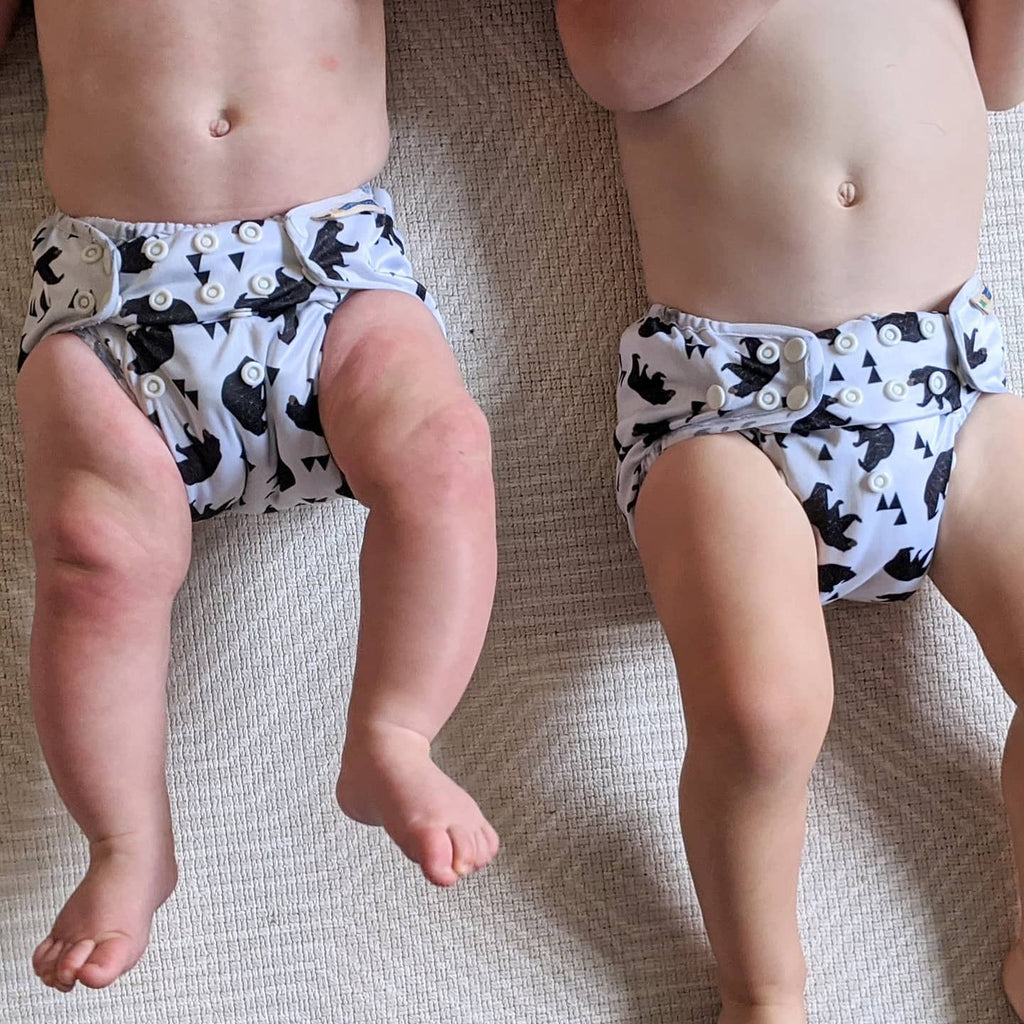
Cloth Diapering 101  


So, you’re expecting a baby and are considering cloth diapers. Wonderful! As you may have realized there is a lot of information available on line.

Cloth diapering is very simple. Your most confusing part will be selecting the diapers you want to buy. This can be broken down into 5 basic categories but what you need to know before we touch on the categories is that all diapers require the use of a water proof barrier. 

A disposable diaper’s waterproof barrier is called the back sheet which is used to prevent liquids from leaking out of the diaper.  Contrary to popular belief the cloth like back sheet is not cloth, it is made of plastics disguised to feel and look like cloth.


With cloth diapers the waterproof component is called the diaper cover. It provides the same service as the disposable diaper’s back sheet but unlike a disposable it is not thrown away following a single use. As will be covered in the 5 basic categories the diaper cover will either be attached to the cloth diaper or put on separately over top of the cloth diaper, this is referred to as a “two step system”.  

The waterproof cover is the most important component in the 5 basic categories of cloth diapers.  It plays the biggest role in your cloth diapering experience. With all the information “out there” on cloth diapering, very little is known or shared about the importance and structure of the diaper cover itself. It has the power to determine how much you will enjoy cloth diapering! 

One size fits all diapers are very popular as they cut costs significantly by eliminating the need to purchase multiple sizes as your baby grows.  You need to know that all one size diapers are cut and made to fit a larger child (the upper weight range) and somehow adjust to accommodate a small baby. They never do that well, there is always a compromise in the fit of one of the weight ranges, often more.

A cloth diaper is considered a hygienic item. How much you enjoy cloth diapering will be determined by two factors: 1. "Leakproofness" of the system you choose, and 2. Absorbency - which determines how often you need to change the diaper.


The 5 basic categories:

All diaper systems will fall into one of the following 5 categories.  The pros and cons section will help you decide which system is right for you. Your budget will determine which category you want to focus on. 

 
  1) Flat/ Prefolded and Contoured Cloth Diapers

Part of a “two step” diapering system meaning the cover is put on separately from the diaper.
These diaper types have been around for generations and are the most economical. They are
rectangular or squares of absorbent fabric folded to suit the size of the baby.  Prefolds and Contoured (hour glass shaped) (available in a number of sizes) have a few layers sewn to the middle of the rectangular fabric to make the centre more absorbent.  They are available in a variety of fabric types including unbleached and organic cottons, hemp and bamboo. They have no closure systems.
 
  Pros      
  Flats are one size fits all, and so, very economical.
If you are on a tight budget and don’t mind folding some diapers before using them on your baby these diapers are for you.


  Cons      
  Requires the use of a separate waterproof cover
Must be folded prior to use
Don’t contain messes well (no leg elastics)
Since messes aren’t often contained in the diaper itself more waterproof covers are required
Must be secured with some fastening method –pins, clipped, or a snug fitting waterproof diaper cover.
Prefolded and Contoured - Diapers come in different sizes- increasing the cost accordingly


  Note: Motherease makes the waterproof diaper covers for these types of cloth diapers but doesn’t make flat or prefolded diapers and so we direct you to the real cloth diaper association for guidance on where they can be purchased:
http://www.realdiaperassociation.org/
 
         
  2)  Fitted Cloth Diapers ( One Size, Sandy'sEconoME )

Part of a “two step” diapering system- meaning the cover is put on separately from the diaper.
 

A very popular choice and more economical than the next two categories.  These are absorbent contoured diapers shaped to fit a baby with elastics at the waist and leg openings.  Waist closures of some sort are usually included.  They are available in a number of sizes for a customized fit as baby grows or they are available in a one size fits all. Fitted cloth diapers are available in a variety of popular fabric choices.

  Pros      
  Great containment due to elastics at waist and leg openings.
More affordable as this system requires the least amount of waterproof covers
Great longevity- as the cover is not attached- suitable as a one size fits all option
Depending on the brand you select, these are very absorbent diapers, often touted best for night or nap times or longer car trips.

 
  Cons      
  Requires the use of a separate waterproof cover
Longer drying times – varies depending on how many layers are sewn together
Elastics may not endure the length of time a child will wear the one size fits all option
 
         
  3)  Pocket Diapers    EasyStuff )

A relative newcomer to the cloth diaper scene.  With this diapering style the waterproof diaper cover is
 
sewn to an inner (usually synthetic) layer in a manner that leaves an opening, usually along the back of the diaper for turning it inside out during production but also to accommodate the addition and removal of the absorbent component/insert. It is considered a two piece system in that the absorbent component, often referred to as an insert, is added separately to make it ready to use as a complete diapering system.  Inserts are available in a variety of fabric choices.    Pocket diapers have elastic at the waist back and leg openings.  Waist closures of some sort are always included.  Pocket diapers are very slim fitting, available in one size fits all and sized for a more perfect fit in each size range.  Wide range of colours and prints for fashion conscious parents.


  Pros      
  “One step” diapering system – meaning the diaper is put on in one simple step - once the inset has been added
Dry quickly- because absorbent component is removed
Good for child care providers and grandparents

     
  Cons      
  Absorbent component/insert must be added to each diaper before use and removed after use, prior to washing.  Removal can be unpleasant.
Expensive as the waterproof cover is attached/included with each diaper
Cover and inner layer are cut to the same size so a pocket diaper can become quite convex when additional inserts need to be added for sufficient absorbency.  This can cause leakage as liquid can run off the rounded surface quicker than it can absorb. Waterproof cover component is the first part of the system to expire- applicable particularly with one size fits all style
Elastics may not endure the length of time a child will wear the one size fits all option
Not very leakproof


4) All In Ones    Uno )

These cloth diapers combine the fitted diaper with the waterproof cover into one product.  It is a one piece


system as the absorbent component is sewn in and not removable.  It is an ideal alternative to a disposable diaper and considered easiest to use.  They always include elastic at the waist and leg openings and the waist closes with either a hook and loop or snap closure system.  These diaper systems are available in one size fits all, or sized for a more perfect fit in each size range.  They often sport a slim fit and are available in a variety of colours and prints for fashion conscious parents.

 
  Pros      
  A one step diapering system- meaning the diaper is put on in one simple step
Great for child care providers and grandparents as they are an easy and quick change
This style of diaper is ideal to supplement other cloth diapers when convenience is a factor such as a quick diaper change at the mall.
 
  Cons      
  Expensive as the waterproof cover is attached/included with each diaper
Can be slow to dry depending on construction techniques.  The attached waterproof cover can impede the water extraction during machine’s spin cycles
Waterproof cover component is the first part of the system to expire- applicable particularly with one size fits all style
Elastics may not endure the length of time a child will wear the one size fits all option
Depending on construction technique, not very leakproof
 
         
  5) Hybrid or All In Two diaper systems    ( Duo - One SizeDuo - Two Size )

The newest member on the cloth diaper scene.  Fewer covers are required for this style of diapering system than pocket diapers or All in One diapers where the cover is “built in”. The absorbent component
is attached to an accompanying cover by a means that makes it removable (usually snaps) and holds the diaper/insert in place.  Some manufacturers provide a simple absorbent flat absorbent liner/insert that snaps to and out of the cover.  Yet other manufacturers supply fitted diaper/inserts (which also snap to and out of the cover) with elastics at the edges to better prevent leakage. Also available from some manufacturers are disposable inserts.  Less covers are required as soiled diaper/inserts are replaced, and provided the cover isn’t soiled, and the same cover is reused.  Once the diaper/insert is attached to the cover it becomes an All In One style diaper and very convenient to use.  Both the waterproof covers and the absorbent inserts are available in one size fits all, or multi-sized for a more perfect fit in each size range.  Diaper/inserts are available in a variety of fabric choices.  Hybrids or All In Twos often sport a slim fit and the covers are available in a variety of colours and prints for fashion conscious parents.
 
     
  Pros      
  A one step diapering system - meaning the diaper is put on in one simple step - once the diaper/insert is attached to the cover
Faster drying times as the absorbent diaper/insert is detachable
More cost effective as less waterproof covers are required
Great longevity as the cover is not attached- Diaper/Inserts suitable as a one size fits all option
Cost effective to replace the covers as required, once expired
Great for child care providers and grandparents as diapers can be preassembled for as many covers as you have and used as all in ones

     
  Cons      
  Absorbent component/insert must be added to each diaper before use and removed after use, prior to washing.  Removal can be unpleasant.
Waterproof cover component is the first part of the system to expire- applicable particularly with one size fits all style


  At Motherease we are well known for the high quality of our product lines.  Also unique to ME is our reputation for our leakproof  cloth diapering products.  We sell the products we make in our own manufacturing plant which we have powered with Green Energy.